


Federated Learning: Training AI Models Without Compromising Data Privacy
As organizations accelerate their adoption of artificial intelligence, data has become the most valuable asset driving innovation. However, with increasing concerns around data privacy, regulatory compliance, and cybersecurity, enterprises face a significant challenge: how to leverage sensitive data without exposing it.
Traditional machine learning approaches require centralizing data into a single repository for training models. This creates risks related to data breaches, compliance violations, and loss of customer trust. In highly regulated industries, this approach is often not feasible.
Federated learning emerges as a transformative solution to this problem. It enables organizations to train AI models collaboratively without transferring raw data, ensuring privacy is preserved while still unlocking the value of distributed datasets. This approach is rapidly gaining traction as businesses seek secure, scalable, and compliant AI strategies.
What is Federated Learning?
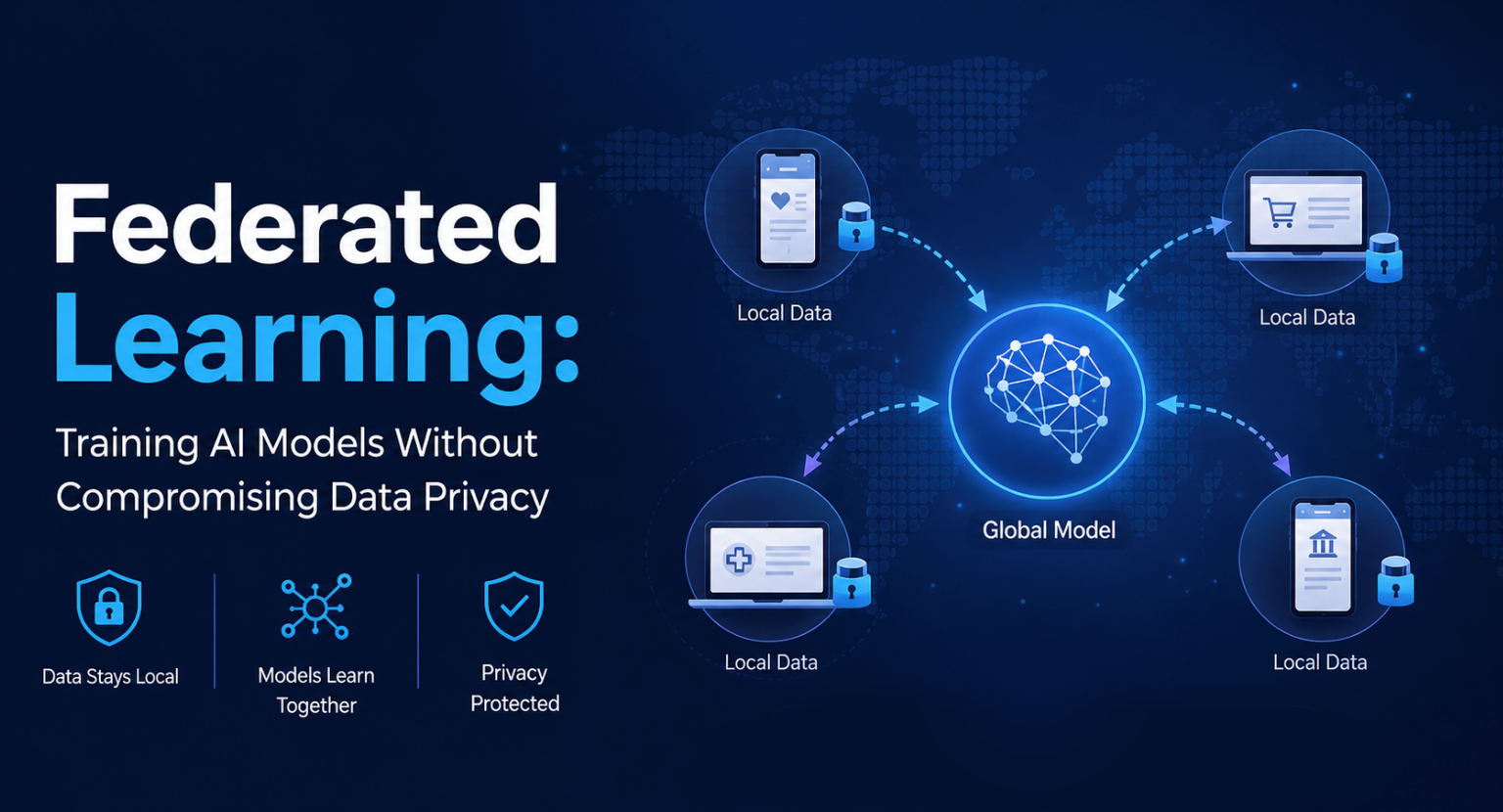
Federated learning is a decentralized machine learning approach where models are trained across multiple devices or servers without moving the underlying data.
Instead of collecting data into a central location, the model is sent to where the data resides. Each node (such as a device or local server) trains the model using its own data and sends back only the model updates. These updates are then aggregated to improve the global model.
Key Characteristics
Data Stays Local
Sensitive data never leaves its source, significantly reducing exposure risk.
Collaborative Learning
Multiple participants contribute to improving a shared model without sharing raw datasets.
Secure Model Updates
Only encrypted model parameters or gradients are transmitted.
How Federated Learning Works
Understanding the workflow of federated learning helps clarify its enterprise value.
Step 1: Initial Model Distribution
A global AI model is initialized and distributed to multiple participating nodes.
Step 2: Local Training
Each node trains the model using its own dataset, ensuring data privacy is maintained.
Step 3: Model Update Sharing
Instead of sending data, nodes send model updates (gradients or weights) back to a central aggregator.
Step 4: Aggregation
The central server aggregates updates from all nodes to improve the global model.
Step 5: Iteration
This process repeats until the model reaches the desired level of performance.
Why Federated Learning Matters for Enterprises
Addressing Data Privacy Challenges
Data privacy is a top concern for modern enterprises. Federated learning minimizes the need to transfer sensitive data, helping organizations maintain compliance with strict data protection regulations.
Enhancing Data Security
Since data remains decentralized, the risk of large-scale breaches is significantly reduced. Even if a system is compromised, only limited information is exposed.
Enabling Cross-Organization Collaboration
Organizations can collaborate on AI models without sharing proprietary or sensitive data. This opens new opportunities for innovation across industries.
Reducing Data Transfer Costs
Moving large volumes of data can be expensive and inefficient. Federated learning reduces bandwidth usage by transmitting only model updates instead of raw data.
Real-World Enterprise Use Cases
Healthcare Analytics
Healthcare organizations often deal with highly sensitive patient data. Federated learning allows institutions to collaboratively train predictive models without sharing patient records.
This enables improved diagnostics, treatment recommendations, and research outcomes while maintaining strict privacy standards.
Financial Services
Financial institutions can use federated learning to detect fraud patterns across multiple systems without exposing customer transaction data.
By combining insights from distributed sources, organizations can enhance risk detection and strengthen security measures.
Smart Devices and IoT
Devices such as smartphones and connected systems generate vast amounts of data. Federated learning enables these devices to contribute to AI improvements without transmitting personal data.
This approach is widely used for features like predictive text, voice recognition, and personalization.
Retail and Customer Insights
Retail organizations can analyze customer behavior across multiple platforms while ensuring data privacy. Federated learning enables better demand forecasting, recommendation systems, and customer engagement strategies.
Benefits of Federated Learning
Improved Privacy Compliance
Federated learning aligns with strict data protection requirements by ensuring sensitive data remains within its original environment.
Scalable AI Training
Organizations can scale AI training across multiple data sources without centralizing infrastructure.
Better Model Performance
By leveraging diverse datasets from multiple sources, federated learning can improve model accuracy and generalization.
Increased Trust
Customers and stakeholders are more likely to trust systems that prioritize data privacy and security.
Challenges and Considerations
While federated learning offers significant advantages, enterprises must address several challenges.
Data Heterogeneity
Data across different nodes may vary in quality, format, and distribution. This can impact model performance and requires advanced techniques to manage effectively.
Communication Overhead
Although data transfer is reduced, frequent communication of model updates can still create network overhead, especially in large-scale systems.
Security Risks in Model Updates
Even though raw data is not shared, model updates can potentially leak information if not properly secured. Techniques like differential privacy and secure aggregation are essential.
Infrastructure Complexity
Implementing federated learning requires robust infrastructure, orchestration, and monitoring systems.
Technologies Enabling Federated Learning
Several technologies and frameworks support federated learning implementations.
Secure Aggregation Techniques: These ensure that individual model updates cannot be reverse-engineered to extract sensitive data.
Differential Privacy: Adds noise to model updates to further protect data privacy while maintaining accuracy.
Edge Computing: Processing data at the edge reduces latency and enables efficient local model training.
AI Frameworks: Modern machine learning frameworks provide tools for building federated learning systems, making it easier for enterprises to adopt this approach.
Future Trends in Federated Learning
Federated learning is expected to play a critical role in the future of AI.
Integration with Edge AI: As edge computing grows, federated learning will become more efficient and widely adopted.
Increased Regulatory Adoption: Organizations will increasingly adopt federated learning to meet evolving data protection requirements.
Cross-Industry Collaboration: More industries will collaborate on shared AI models without compromising sensitive data.
Enhanced Security Mechanisms: Advancements in cryptographic techniques will further strengthen the security of federated learning systems.
Final Thoughts
Federated learning represents a major shift in how organizations approach AI model training. By enabling decentralized learning, it addresses one of the biggest challenges in modern AI: balancing innovation with data privacy.
For enterprises, this approach offers a powerful way to leverage distributed data, improve model performance, and maintain compliance with strict privacy standards. While there are challenges in implementation, the long-term benefits make federated learning a strategic investment for forward-thinking organizations.
As businesses continue to prioritize data security and trust, federated learning will become an essential component of enterprise AI strategies.
Need Help with AI Implementation?
If your organization is exploring secure and scalable AI solutions, Swayam Infotech can help you design and implement advanced AI systems, including federated learning architectures tailored to your business needs.

 English
 French
 Spanish
 Portuguese
 Deutsch
 Turkish
 Dutch
Dutch
 Italiano
 Russian
 Romaian
 Portuguese (Brazil)
 Greek
Greek