

Are Standing Desks Good for Writers? 8 Key Insights
Writers spend long stretches at the keyboard, and the search for better posture, focus, and energy often leads to one question: can standing desks actually improve the craft of writing? Short answer: yes — but with nuance. Standing workstations can reduce the physical downsides of sitting, change how you structure your writing days, and influence creativity and productivity. In this article we look at eight practical insights for writers, explain trade-offs, and offer suggestions on choosing the right setup — whether that’s a sit-to-stand desk, a corner layout, or a higher-end standing executive option.
https://www.vernalspace.com/co....llections/standing-d
Best Standing Desks for writers — what matters most
“Best” depends on how you write. For a novelist who edits long drafts, stability and a wide work surface matter most; for a content creator who moves between note-taking and drafting, a versatile height range and quick transitions are priorities. Core criteria to consider include a sufficiently broad height span to support both sitting and standing, low wobble at full extension, smooth adjustment (manual or electric), and enough surface depth for a laptop and notes or reference books. The best standing desks balance these qualities without overcomplicating your workflow.
Sit to Stand Desk: rhythm and writing stamina
A Sit to Stand Desk is most effective when used with a predictable rhythm. Many writers report that standing for short blocks — for example, 20–30 minutes every hour — reduces afternoon fatigue and helps sustain focus during editing or revision. The key is to make the transitions predictable: use a timer or build standing into specific task types (stand for calls and quick edits; sit for deep drafting). That predictability prevents position changes from becoming a distraction.
https://www.vernalspace.com/pr....oducts/vernal-height
Adjustable Desks and ergonomics for keyboard-heavy work
Adjustable Desks give you the ability to fine-tune keyboard and screen height for neutral wrists and a relaxed neck. For writers, maintaining a neutral typing posture reduces micro-tension that accumulates during long stretches of prose. A good rule: when standing, your elbows should sit at roughly a 90-degree angle and the top of the monitor should be at or just below eye level. Adding a compact keyboard tray or a low-profile mechanical keyboard can further improve wrist position without losing precious desktop space.
Electric Adjustable Standing Desk: convenience that keeps focus
An Electric Adjustable Standing Desk makes switching seamless — a single button press returns the desk to your saved sitting or standing height. For writers, the convenience reduces interruption: if you’re in a flow state, a quick transition is less likely to break momentum. Look for quiet motors and memory presets so you can change posture with minimal friction. The trade-off is higher cost and slight complexity, but for frequent transitions the frictionless operation often pays dividends in sustained productivity.
https://www.vernalspace.com/pr....oducts/vernal-l-shap
Corner Standing Desk: maximize workspace without losing calm
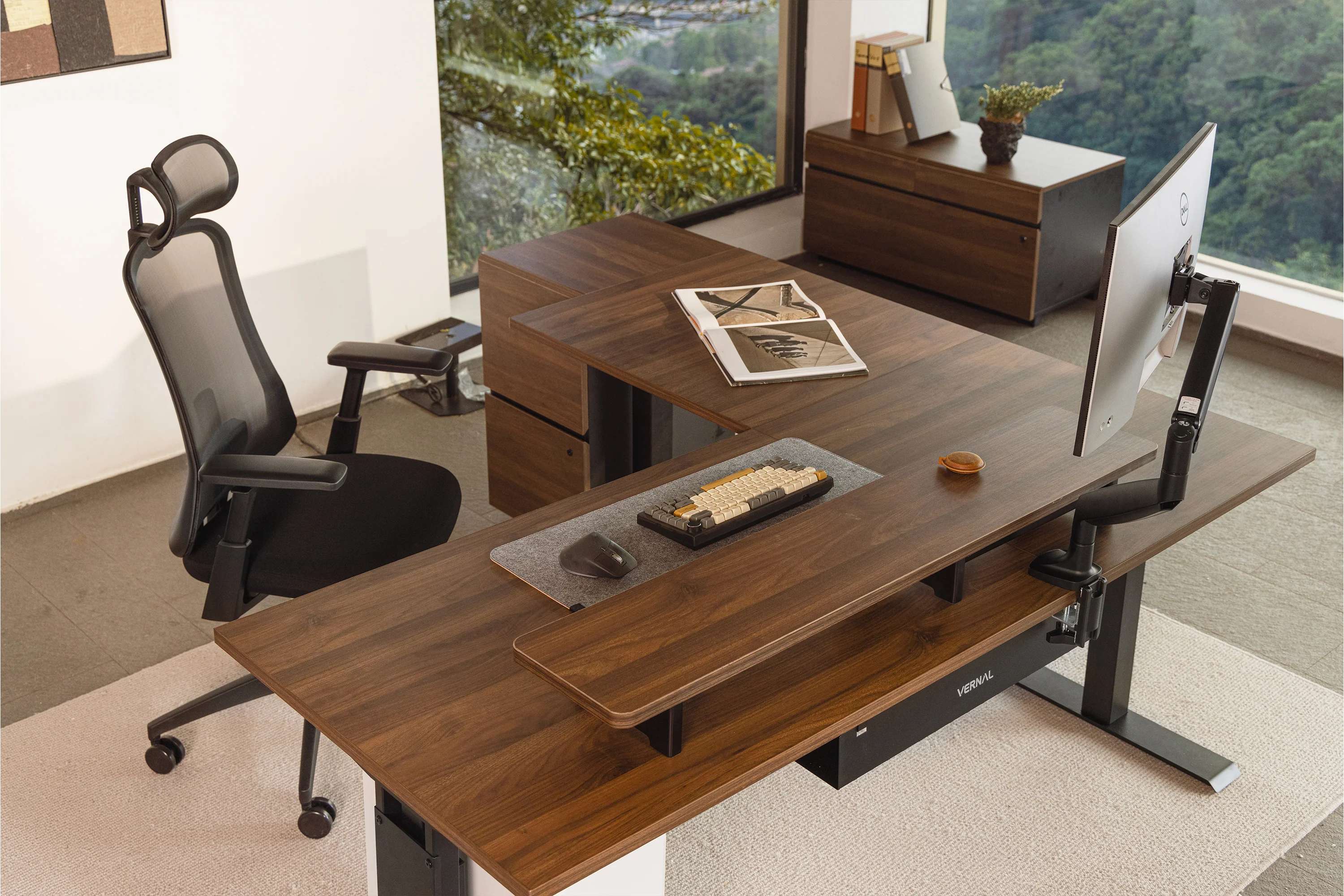
If your writing setup includes multiple screens, reference books, or a sketchpad for plotting, a Corner Standing Desk makes efficient use of room geometry. The L-shaped layout supports task zoning: one wing for research and references, the other for the active drafting area. Corner desks can make it easier to spread materials during edit passes while leaving the main typing zone free for standing. For writers who collaborate or teach, corners also create a semi-private hub within a shared space.
Standing Executive Desk: presence, comfort and long-form work
A Standing Executive Desk brings a larger surface and often a more polished finish, which can serve as a physical command center for long-form writers who juggle many resources. The extra desktop room accommodates printouts, multiple monitors and ergonomic accessories — and psychologically it can signal “this is my serious work area,” which helps condition focus. If you choose an executive-style top, prioritize a strong, wobble-resistant frame to avoid distracting movement during typing.
https://www.vernalspace.com/pr....oducts/vernal-execut
Solid Wood Standing Desk: aesthetics, acoustics and attention
Material matters. A Solid Wood Standing Desk adds warmth and tactile quality that many writers find comforting. Wood can soften sound and create a calmer sensory environment compared with glass or glossy laminates. That subtle sensory comfort can improve concentration and make the act of sitting down or standing up feel more deliberate — useful for building ritual around writing sessions. Protect the surface with a pad for heavy use and choose sealed finishes if you frequently use beverages at your desk.
https://www.trustpilot.com/review/vernalspace.com
What reviewers and peers say — Vernal Desk Reviews and practical lessons
When considering branded options, many writers consult user feedback such as Vernal Desk Reviews to understand real-world stability, noise levels and assembly experiences. Reviews often highlight differences between advertised specs and daily use: a desk that’s technically rated for a high load might still wobble without reinforced crossbeams, for instance. Use reviews to check for common issues (unsteady frames, noisy motors, missing parts) and to learn useful setup tips from other writers — like ideal monitor arm placements or anti-fatigue mat recommendations.
Putting it together: recommended workflow for writers
Here’s a lightweight protocol to start using a standing setup without losing flow:
Set ergonomic baselines: monitor top at eye level; keyboard at elbow height.
Program presets: save one sitting and one standing height (electric desks are best here).
Use task-specific posture: stand for revision, meetings, or short creative bursts; sit for uninterrupted drafting.
Start small: 15–25 minute standing blocks and grow as comfort increases.
Track and tweak: note energy, neck tension and typing speed for two weeks and adjust accordingly.
Conclusion
Vernal Standing Desk can be a meaningful tool for writers — if they’re chosen and used with intention. Whether you opt for one of the Best Standing Desks on the market, a simple Sit to Stand Desk, an Electric Adjustable Standing Desk for frictionless changes, a Corner Standing Desk for complex setups, a Stand Up Executive Desk for presence, or a Solid Wood Standing Desk for sensory comfort, the benefits come from routine and ergonomics more than the piece of furniture itself. Consult user experiences like Vernal Desk Reviews when considering a branded purchase, and remember: the best desk is the one you actually use.